Overview
The Creative Production (Music) MA offers you a rigorous framework for developing your own artistic practice at postgraduate level, in one of the world's most active cities for experimental music and sound art.
The programme is practice-led and self-directed. You define your own research project, develop your methodology and determine the form your work takes. Rather than prescribing outcomes, it is designed to stimulate curiosity, widen and deepen your frames of musical and conceptual reference, and provide the critical tools and supervisory support to pursue your ideas with rigour. Workshops, seminars and guest sessions ground your work in practice-led research methodology and connect it to a broader field of inquiry across sound, music and the arts.
This is not a studio engineering degree, a vocational production course or a genre-based music programme. It is postgraduate artistic research, and it asks something specific of those who come to it: a willingness to define their own questions, develop their own methods and take their practice somewhere it has not yet been.
The programme is available full-time over one year or part-time over two years, and is taught entirely in English.
What is creative production?
Creative production is an intentionally broad term. Within music it encompasses composition, recording, programming, performance, sound design, improvisation, instrument design, sound art, field recording, creative coding, spatial audio and interdisciplinary practice. For this programme, it refers to the iterative process of production and reflection rather than any specific outcome or medium.
“Most importantly, it is what you do with the resources that are given to you that makes each study experience unique. This is a space where you have a certain autonomy and can explore your creative desires. You're in charge!”
– Pablo Diserens aka Ōtone, music producer and Creative Production (Music) MA alum
Course structure
Course structure
The programme moves through five modules: Imagine, Contextualise, Investigate, Present and Synthesise. Together they form a complete arc from initial research proposal through to a final body of publicly presented work.
Imagine
The first part of the programme focuses on the development of a detailed research proposal, a research contract and a work plan, agreed between you and your supervisor. This is where your project takes its first real shape.
Contextualise
A comprehensive review and exploration of current practices within your field. You will critically examine existing concepts, literature, practices and methods, then place your own research in that context while identifying the themes and trajectories that will drive your investigation.
Investigate
The Investigation module begins with breadth: a survey of the area, discipline or concept central to your research. Using that foundation, you go into greater depth in specific aspects of your project, whether through particular paths of artistic practice, the development of technical approaches, or an incisive conceptual framework. Different lenses, applied to the same body of work.
Present
The creation, presentation and documentation of public-facing work. You will experiment, observe and refine your practice in outward-facing, real-world contexts. This module bridges the investigative phase with the final Synthesise module.
Synthesise
The culmination of your research and making. You are expected to produce a substantial piece of original work, or body of works, drawing on the full breadth and depth of the knowledge, methods and artistic experience developed throughout the programme.
Download the course guide for the full module breakdown and tuition plans.
Workshops and supervision
Three workshops run concurrently across the year, each approaching your project from a different angle.
Creative Sound Practices
The practical backbone of the programme. Weekly sessions move fluidly between modular synthesis, spatial sound, creative coding, field recording, improvisation and sound installation. Tools, ideas and processes are treated as creative materials to be bent, hacked and reimagined. The aim is not technical mastery but the development of a personal methodology that connects exploration with critical reflection.
Contexts of Listening
The theoretical context of the programme. Drawing on musicology, sound studies, philosophy and critical theory, it provides conceptual tools to analyse and articulate your practice. The class engages with thinkers including Pauline Oliveros, George Lewis, Jacques Derrida, Walter Benjamin, Rosi Braidotti, Roland Barthes, Nina Eidsheim, George Lipsitz, Isabella van Elferen, Jacques Attali, Judith Butler, Mark Fisher, Pierre Schaeffer and Suzanne Cusick, among others. Theory is treated as a living resource: sessions evolve in response to student research.
Supervision
One-to-one and group meetings with your supervisor run throughout the programme. Individual sessions keep your research on track. Group sessions function as forums for project development, peer critique and invited seminars.
Guest artists
Presentations from guest artists have included Nicolas Collins, Sabine Vogel, Bob Ostertag, Kaffe Matthews, Insa Langhorst, Sanja Starvic, Marta Zapparoli and Kazuhisa Uchihashi, among others.
Download the course guide for the full module breakdown and tuition plans.
Is this programme for me?
The programme is designed for composers, sound artists, experimental musicians, improvisers, performers and interdisciplinary practitioners who want structured freedom to develop their practice at postgraduate level. Students come from a wide range of backgrounds: those whose practice has outgrown its current context, sound artists seeking a rigorous research framework, practitioners working across spatial sound, installation, performance and creative coding, and artists whose work sits between disciplines.
You’ll find this course suitable if you’re interested in:
- This course is for you if:
- You’re ready to dive deeply into your own artistic practice and ideas.
- You want to refine your creative vision through focused research and production.
- You’re curious to explore new techniques, concepts and ways of making music.
- You see value in independent, practice-led inquiry with expert mentorship.
- You’re interested in how your work connects to broader creative and cultural landscapes.
- You want to be part of an international artistic community that challenges and inspires you.
- You’re excited to live and create in Berlin, a city known for pushing musical boundaries.
This programme is not suited to those seeking vocational production training, DAW certification or a genre-based music course.
What type of students take this programme?
Our MA students have come from various backgrounds, including songwriting, house, techno, folk, jazz, composition for dance choreography, experimental and electroacoustic music and free improvisation.
Previous student projects include themes such as field recording and hydraulic sounds, artificial intelligence, human voice and spirituality, hauntology, Janet Jackson, the roles of electronics and sampling in popular music, semiotics, free improvisation and song forms, interactive delay network installation, culture jamming and 4D multichannel composition using the internationally unique Monom system based at the Funkhaus.
If you'd like to receive a final project portfolio from a recently graduated MA student, please contact our Admissions team and we'll be happy to share the document with you for reference.
What is an MA project proposal and what should it contain?
As part of the application process, you will be asked to submit a project proposal: the starting point for the research you intend to pursue during the programme. Before you begin, we recommend familiarising yourself with the principles of artistic and practice-based research.
If you are uncertain whether your project and practice are suited to this programme, the most direct route is a conversation with the admissions team. You can also request a final project portfolio from a recently graduated student for reference.
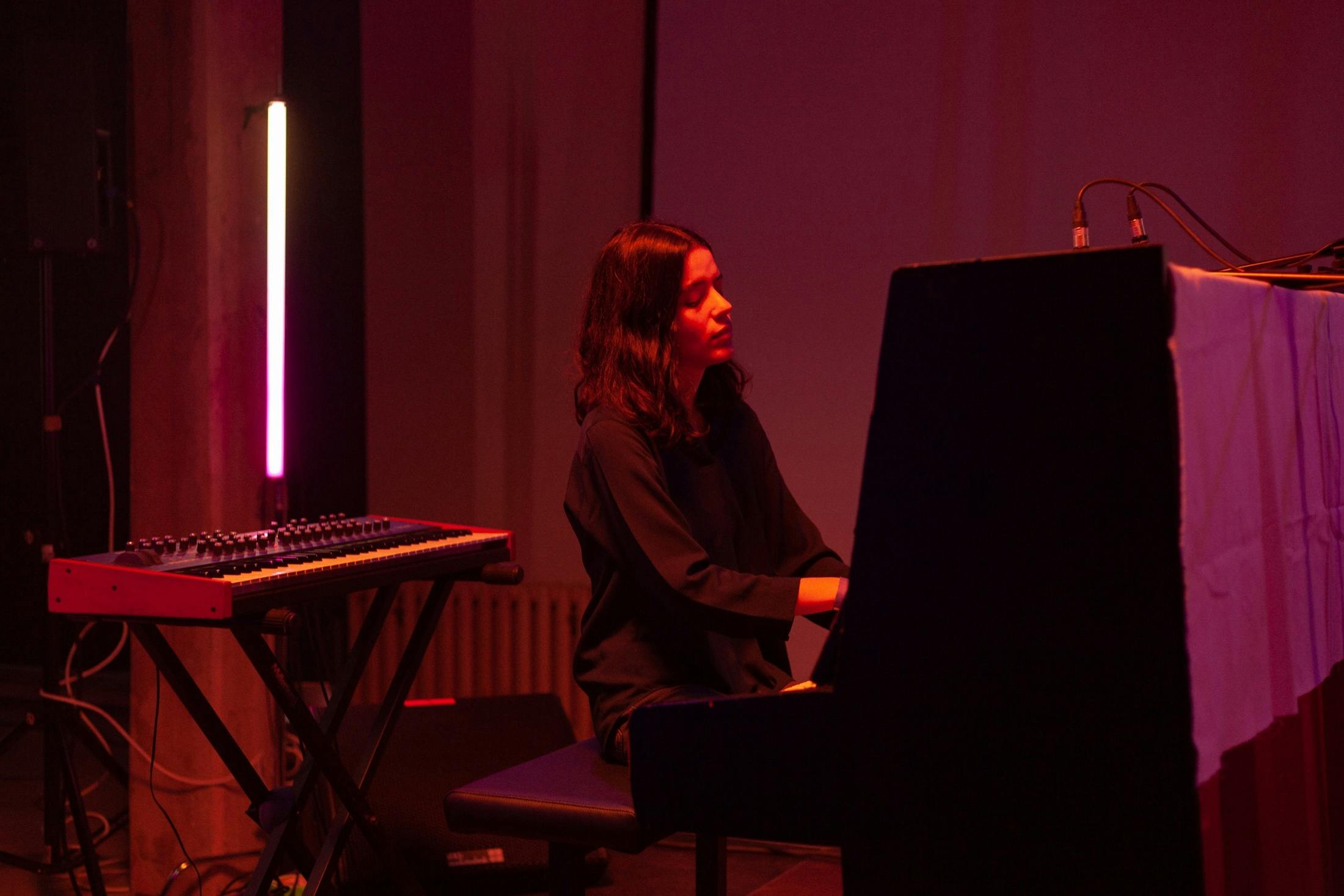
“My favourite part of learning here was the access to the incredible studios. It helped uncover my creativity and explore different aspects of my musical and artistic journey.”
– Sofi Paez, pianist and Creative Production (Music) MA alumna
An international learning community
You will study alongside a small cohort of advanced practitioners from around the world, drawn from backgrounds including experimental and electroacoustic music, free improvisation, composition for dance, house, techno, folk, jazz and songwriting. Your peers are collaborators, critics and fellow travellers, functioning as both audience and sounding board throughout the year and beyond.
MA students are also part of Catalyst's wider campus community at the Funkhaus, where students from the School of Music and Sound, School of Film and Visual Media, School of Acting and School of Creative Human Development share the same building. Cross-disciplinary exchange is part of how the campus works.

Student experience
The programme is embedded in Berlin's experimental arts ecosystem. Each year it engages with Atonal, CTM, Floating University and MANIFEST:IO. The annual MA Symposium is a public two-day research event where students present their work alongside visiting researchers and international practitioners, open to the wider city. The student-run Etikett Radio broadcasts live from our campus, with special partnerships with Refuge Worldwide and Cashmere Radio.
Beyond the curriculum, the T.A.P.E. experimental ensemble, Artistry Connect and regular Guest Sessions with visiting artists offer further opportunities for collaboration and exchange. Wellbeing support, coaching and specialist workshops are available throughout.

Progression & careers
There is no single career pathway this programme prepares you for. It develops your capacity to define, pursue and articulate an independent artistic practice at a high level, alongside the professional skills to sustain it: funding applications, artist statements, residency proposals and the practical realities of a freelance creative life. The direction that practice takes is determined by the work itself.

Postgraduate Symposium
Catalyst's MA Symposium is an annual two-day event where our Master’s students present their artistic research alongside international artists and academics. It’s a dynamic platform for sharing performance, film, sound, installation and experimental work developed during their MA journey.
For students, it’s a unique chance to showcase their research publicly, engage in critical dialogue and connect with a global creative network. It marks a powerful moment of reflection, visibility and growth — and highlights how artistic research can shape not just art, but society.

“I think sometimes we engage in art in a very individualistic way, but discovering how this MA creates a sense of community… it has been a superb experience”
– Alexei Galar, composer, sound designer and Creative Production (Music) MA alumnus
Learn from the experts
Throughout the programme you’ll learn from industry-acclaimed experts in their field, with a passion for passing on their knowledge to others.
Your Programme Lead
Dr. Richard Scott is a composer and performer specialising in electronic and improvised music, with a focus on analog modular synthesis. His practice also includes Ambisonics, multichannel diffusion and custom instruments such as the Buchla Lightning/Thunder and his own WiGi interface, developed during an artistic residency at STIEM. He has collaborated with leading figures in experimental music and draws on influences ranging from Cabaret Voltaire and Lee “Scratch” Perry to Indian classical and West African traditions.

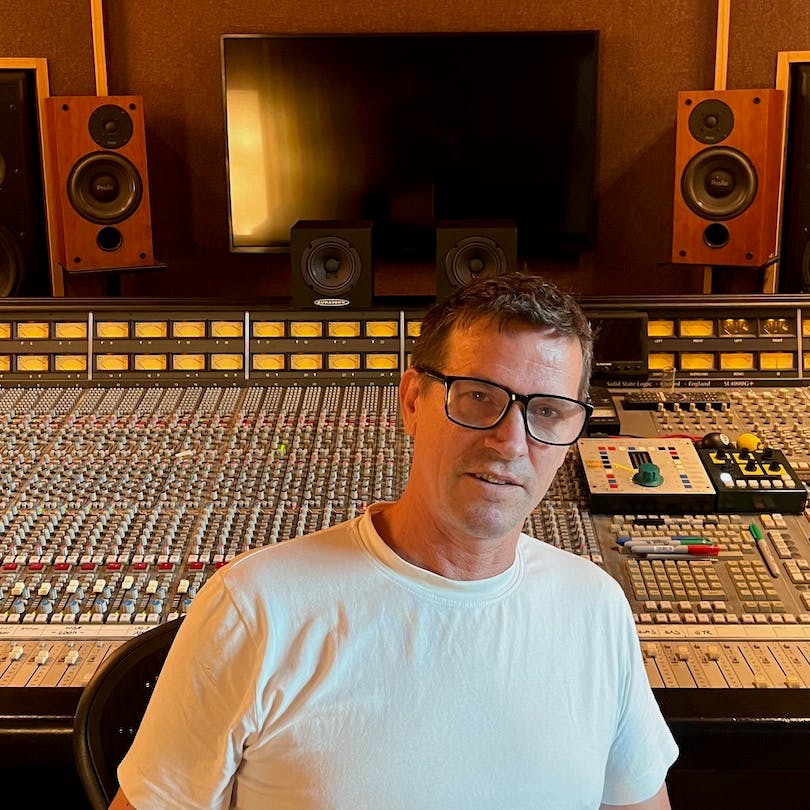


“The programme gave me the creative space to pinpoint the direction I wanted for my artistic career. Richard Scott was very good at gently introducing ideas that I could make my own. I started the MA thinking that I knew what I wanted to do already but quickly found that new ideas created new possibilities.”
– VIBKO, electronic musician and Creative Production (Music) MA alumnus
Ways to connect
Whether in person or online, we can't wait to meet you!


Admissions
Entry requirements
Applicants will be asked to provide: personal and educational information, documentation of their education experience, a detailed project proposal, sample of research/academic writing and a portfolio. Visit our How To Apply page for more detail.
MINIMUM ENTRY REQUIREMENTS
- Standard entry: Bachelor's degree in a relevant discipline, with an Honours grade (e.g. 2:1 in the UK university system).
- Non-standard entry: We recognise that not all education happens in the classroom and it may be possible to admit you through a non-standard access route. If you do not possess the required formal qualification, but have acquired relevant professional or life experience, please contact our Admissions team.
- Language: The language of instruction in all our courses is English and applicants must demonstrate a level equal to IELTS 6 (equivalent to B2 in Germany and other EU countries). You can either submit a language certificate or can take our free 90 min online test.
For more information, please contact our Admissions team and we’d be happy to discuss your opportunities to come study with us.
Course dates and application deadlines
Course start: Mid-September 2026
Applications open: Mid-October 2025
Application deadlines
Visa-required applicants
Applicants from countries requiring a visa before entering Germany:
- General deadline: 30 April 2026 (subject to visa processing time)
EU/visa-exempt or post-arrival applicants:
Applicants from EU/EEA, Switzerland, or countries allowing visa-free entry (e.g. USA, Canada, Japan, South Korea):
- General deadline: 5 June 2026
- Late applications: Until 28 August 2026 (subject to availability)
Priority deadlines & early enrolment bonus
Apply by the priority deadline to secure your place and receive a €1,000 tuition discount.
Early enrolment gives you early access to our visa support service and allows us to plan group sizes and resources in advance.
What does “visa” or “visa-exempt” mean?
- Visa-required: If you require a visa before entering Germany (e.g. citizens of India, Brazil, Mexico, China, Turkey), you must apply at a German embassy before arrival. Our Visa Support Service (included in the enrolment fee) supports you with paperwork, appointments and timelines. Visa processing can take 3–6 months, so early application is essential.
- Post-arrival visa: If you're from a country that allows visa-free entry (e.g. USA, Canada, Japan, South Korea), you can enter Germany without a visa and apply for your student residence permit after arrival.
- Visa-exempt (EU/EEA/Switzerland): If you're a citizen of the EU, EEA or Switzerland, you don't need a visa or residence permit to study in Germany.
You can check your visa requirements here.
Tuition fees - €6,028 per semestre
Payment options*
Full-time
- Per semestre: €6,028 (2 instalments in total)
- Annual payment: €11,693 per year (3% discount)
Part-time
- Per semestre: €3,678 (4 instalments in total)
- Annual payment: €7,134 per year (3% discount)
Other payment options
- Flexible plans: Monthly and extended payment options available
- Upfront discount: Save on total tuition when paying in full
*Enrolment fee: €895 per study year (non-refundable, due before each academic year begins). Visa support is included as part of the enrolment fee.
Financial support
- Full-time eligible for BAföG and other national funding schemes you can check here
Multiple-course bonus:
If you decide to enrol in both a 4-week Summer Short Course and a degree course with us in within two years, you will receive a discount of 500€ on the total tuition.
Funding opportunities
As an officially accredited higher education institute based in Berlin, Catalyst offers access to a range of national funding opportunities for eligible students, including BAföG and other public financial aid schemes available across Germany and the EU.
To learn more about these opportunities and how to apply, visit our full Funding Your Studies guide.
Open days, Q&As and taster workshops
Get a feel for Catalyst and our courses at a range of both online and in-person events. Join us at a Virtual Open Day or an Open Day at our campus in Berlin, chat to our programme leads at Meet The Tutor, or try a taster workshop.
Tune in
Stories from our creative community